

Special pathway for international students

Global Track — Robotics and Artificial Intelligence

A dedicated pathway for international applicants: the same engineering depth as the on-campus degree, but fully studiable online — with remote laboratories, two live time windows and accompanying language and credential-recognition support.

Key facts

Award
M.Sc. Robotics & Artificial Intelligence (Global Track) — a general higher education entrance qualification or a recognised equivalent foreign degree
Volume
120 ECTS · 4 semesters
Study mode
Online with optional lab weeks
Language of instruction
English (accompanying German module)
Time zones
Asynchronous + live sessions in two time windows
Tuition
EUR 9,800 total · EUR 2,450 per semester
Intake
1 October 2027
Deadline
15 July 2027
Download the study plan as PDFGo to application

Shareable PDF with modules, ECTS and delivery mode — in the current language.

Who this pathway is for

The Global Track is designed for graduates of technical degrees outside German-speaking countries who want a European master's qualification in robotics and AI without giving up their home base or their job.

  • Working engineers with 10–20 study hours per week
  • Graduates without German language skills — teaching is in English
  • Applicants in regions without physical access to robotics laboratories
  • Students who prefer part-time study over eight rather than four semesters
What you will be able to do

Learning outcomes follow the second-cycle European qualifications framework and are documented for every module.

  • Model, control and validate autonomous systems in simulation and on hardware
  • Design and evaluate perception and learning methods on real sensor data
  • Integrate safety, ethics and regulatory requirements into the design itself
  • Ship and monitor robotics software reproducibly on edge hardware
  • Plan, conduct and defend an independent piece of research

Recognition and binding information

This page describes the structure of studies. Only the examination and study regulations and the formal offer letter are binding. Accreditation and recognition details: system accreditation by the German Accreditation Council, decision of 12 March 2024, valid until 30 September 2032.

Study plan and module overview

120 ECTS across four semesters. Every module can be studied online; laboratory content runs on simulation and remotely operated benches.

1. SemesterFoundations: mathematics, control and learning

30 ECTS
1. SemesterFoundations: mathematics, control and learning
CodeModuleECTSDelivery
RAI-101Mathematics for Robotics: Linear Algebra and OptimisationTransformations, quaternions, convex optimisation, numerical methods.6Online
RAI-102Robot Mechanics and KinematicsForward and inverse kinematics, dynamics, trajectory planning.6Online
RAI-103Machine Learning I: Models and EvaluationSupervised learning, regularisation, validation, error analysis.6Online
RAI-104Control Engineering and Embedded SystemsState space, PID/LQR, real-time behaviour, microcontroller toolchains.6Online
RAI-105Remote Laboratory I: ROS 2 and SimulationROS 2 nodes, Gazebo/Isaac simulation, remotely operated test benches.6Remote lab

2. SemesterPerception, autonomy and responsible AI

30 ECTS
2. SemesterPerception, autonomy and responsible AI
CodeModuleECTSDelivery
RAI-201Computer Vision and Sensor FusionCalibration, depth estimation, LiDAR-camera fusion, Kalman filtering.6Online
RAI-202Machine Learning II: Deep Learning and Sequence ModelsCNNs, transformers, representation learning, GPU-cluster training.6Online
RAI-203Autonomous Navigation and SLAMLocalisation, mapping, path planning, behaviour architectures.6Online
RAI-204AI Ethics, Safety and European RegulationRisk classes, documentation duties, safety cases, auditability.6Online
RAI-205Remote Laboratory II: Mobile RoboticsTeleoperated driving platforms, data capture, reproducible experiments.6Remote lab

3. SemesterSpecialisation and industrial project

30 ECTS
3. SemesterSpecialisation and industrial project
CodeModuleECTSDelivery
RAI-301Reinforcement Learning and Robot LearningPolicy optimisation, sim-to-real transfer, imitation learning.6Online
RAI-302Elective specialisation: industrial automation, medical robotics or vehicle autonomyOne applied field in depth, with its own standards landscape.6Online
RAI-303MLOps and Systems Engineering for Autonomous SystemsVersioning, edge deployment, monitoring, fault tolerance.6Online
RAI-304Industry project (supervised capstone, location-independent)A real problem from a partner organisation or the student's own employer.9Online + supervision
RAI-305German for engineers (A1–B1, accompanying)Technical language, applications and workplace culture in German-speaking countries.3Online

4. SemesterMaster's thesis and research practice

30 ECTS
4. SemesterMaster's thesis and research practice
CodeModuleECTSDelivery
RAI-401Research Methods and Scientific WritingExperimental design, statistics, reproducibility, publication practice.6Online
RAI-402Master's thesis with colloquium (defendable online)Independent research, two assessors, public defence.24Online + supervision

Total: 120 ECTS

How online study works

Asynchronous first

Every lecture is recorded and released with transcripts, captions and problem sets. Live sessions run in two time windows so students across the Americas, Africa and Asia can attend.

Remote laboratories

Practical modules run on simulated environments and remotely operated test benches. Optional on-campus lab weeks are available but are not required to graduate.

Assessment and integrity

Assessment combines project work, code review, oral examinations and proctored online examinations. The binding rules are set out in examination and study regulations of 1 October 2026 (Official Gazette 04/2026).

Support for international students

Each cohort has a named academic adviser, peer groups organised by time zone, and clinics on credential recognition, visas (if on-campus weeks are chosen) and career entry.

Applying in five steps

  1. 1 — Check eligibility

    A first degree (at least 180 ECTS or equivalent) in engineering, computer science, physics or mathematics; programming experience in Python or C++; English evidence as per English C1 (IELTS 7.0 / TOEFL iBT 95) or German C1 (TestDaF 4x4 / DSH-2), depending on the language of instruction.

  2. 2 — Submit credentials

    Transcripts and degree certificates as certified copies or through a recognised evaluation service. Recognition questions are handled by admissions: recognition under the Lisbon Recognition Convention via the examination board, processed within four weeks.

  3. 3 — Motivation and portfolio

    A statement of purpose (max. 800 words) plus a technical portfolio: repository, project report or publication.

  4. 4 — Online academic interview

    A 30-minute conversation with two academics about prior knowledge, project intent and how the studies fit around work or family.

  5. 5 — Offer and enrolment

    Offer letter, study agreement and access to the digital campus. Fees and dates: EUR 9,800 total · EUR 2,450 per semester, 15 July 2027.

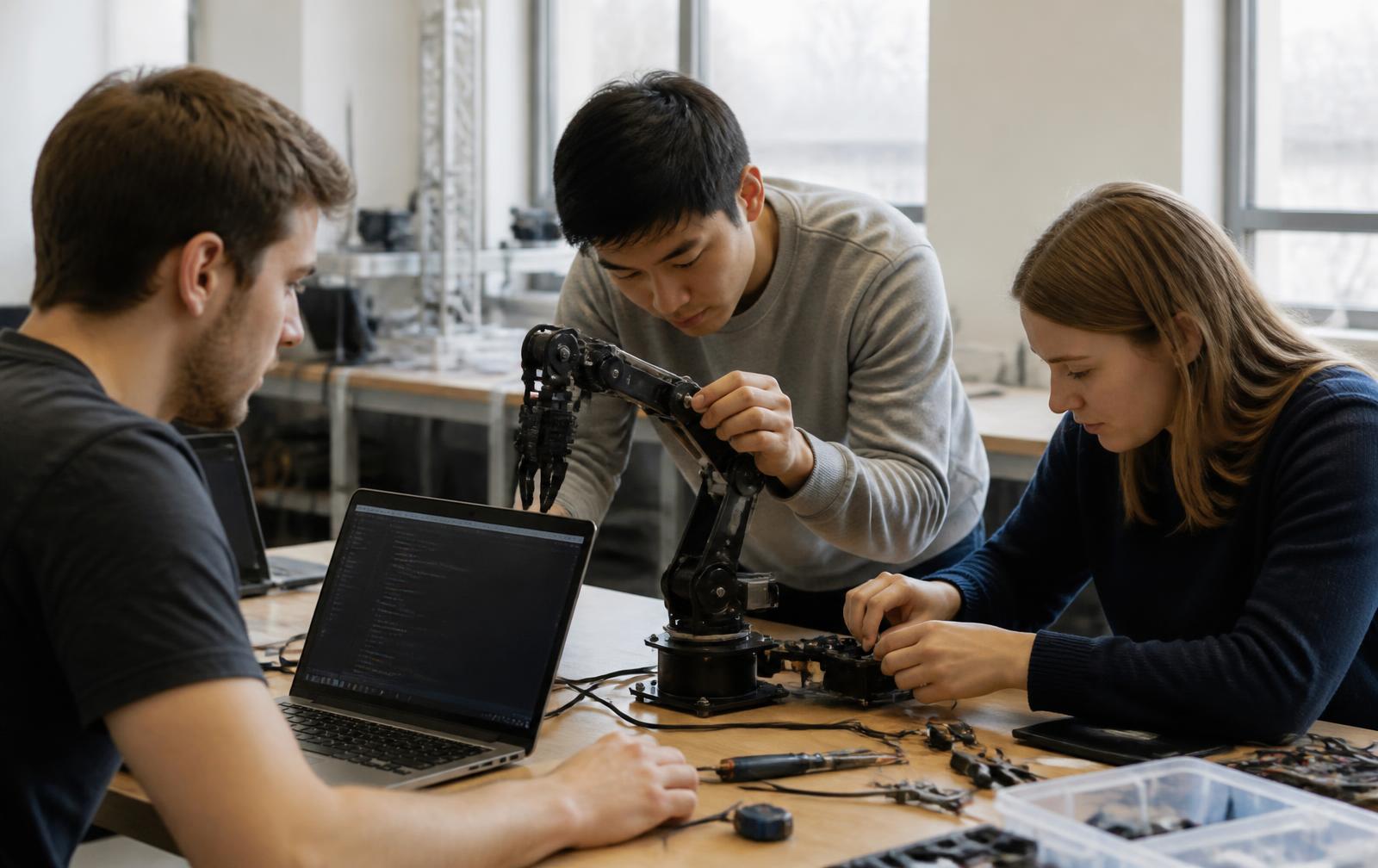
Project team in the TU Eisenfeld robotics lab
Online student working in the remote laboratory

Global Track admission

Applications are reviewed on a rolling basis. Admissions replies come in the language you applied in.

Entry requirements

  • A first degree of at least 180 ECTS (or equivalent) in engineering, computer science, mechatronics, physics or mathematics
  • Demonstrable foundations in linear algebra, calculus and probability
  • Programming experience in Python or C++ (project, repository or professional practice)
  • English proficiency per English C1 (IELTS 7.0 / TOEFL iBT 95) or German C1 (TestDaF 4x4 / DSH-2), depending on the language of instruction; no German required
  • Minimum technical setup: a computer with 16 GB RAM and a stable internet connection

Required documents

  1. 01Degree certificate and transcript (certified copy or recognised evaluation)
  2. 02Curriculum vitae
  3. 03Statement of purpose (max. 800 words)
  4. 04Technical portfolio: repository, project report or publication
  5. 05Evidence of English proficiency
  6. 06Copy of passport or national identity card

Global Track application form

Files are stored by language and by originating page.

Language and origin page of this application: English · /en/international/global-track-robotics-ai

Online study — frequently asked questions

Can I complete the whole degree online?
Yes. All 120 ECTS can be earned online, including the laboratory practicals and the thesis defence. On-campus weeks are voluntary.Related modules:RAI-105RAI-402
How do the remote laboratories work?
You book time slots on real test benches and drive them through a web console with video, telemetry and a safety cut-out. Every hardware run is preceded by validation in simulation.Related modules:RAI-105RAI-205
How much time should I plan per week?
One ECTS equals 25–30 hours of work. Full-time that is roughly 38 hours a week; part-time over eight semesters roughly 19. Live sessions run in two time windows and all recordings stay available.
How is assessment handled online?
Through project submissions with code review, oral examinations by video, and proctored online examinations. The binding rules are examination and study regulations of 1 October 2026 (Official Gazette 04/2026).Related modules:RAI-304RAI-401
What support do I get as a distance student?
A named adviser per cohort, weekly office hours in two time zones, peer groups, technical support for the lab platform, plus guidance on credential recognition and career entry.
What equipment do I need?
A computer with 16 GB RAM, a stable connection from 10 Mbit/s and a headset are enough. Compute-heavy training runs on university GPU resources, not on your own machine.Related modules:RAI-202RAI-303

Study plan and module overview